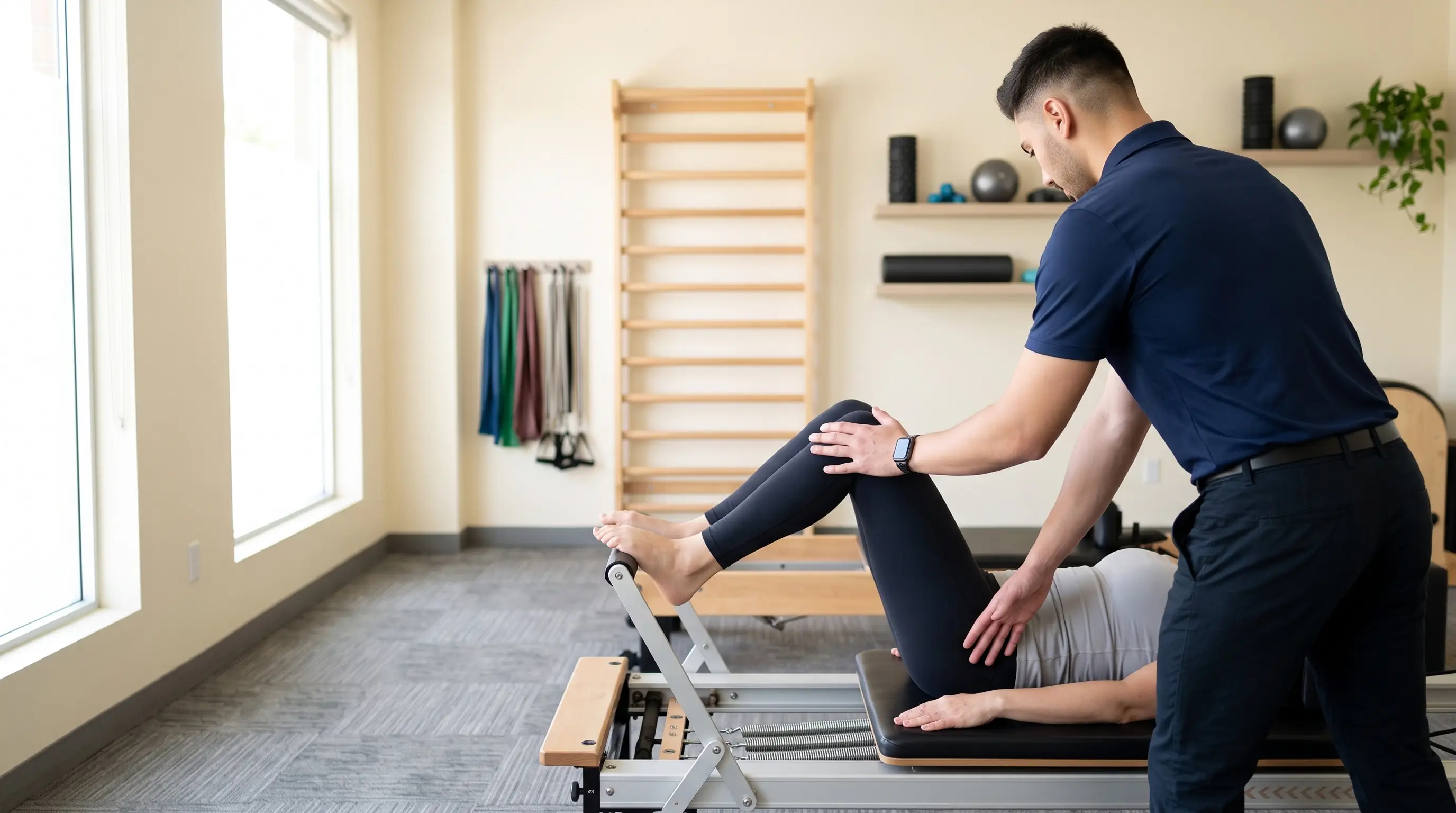
Clinical Pilates is a rehabilitation-focused exercise approach in which Pilates exercises are combined with physiotherapy principles and an individual assessment. It is planned around a complaint, an assessment and personal goals, and carried out one-to-one.
What Is Clinical Pilates?
Clinical Pilates is an individually planned exercise process that begins with a physiotherapy assessment. The person’s pain, restricted movement and the areas that are weak or working without control are identified; the programme is then shaped around these findings and the person’s goals. For this reason, exercises are not given to everyone in the same way; two people in the same session may work towards different goals and at different levels of difficulty. The aim is not general fitness, but a controlled and progressive course of treatment directed at a specific problem.
What Does It Target? Motor Control and Deep Stabilisation
At the heart of Clinical Pilates is restoring the deep muscles that support the trunk and spine (particularly the transversus abdominis and multifidus) to work with the right timing and control. Pain is often linked to a disruption of this deep stabilisation system and of movement control.
Through principles such as breathing, control, centring, precision and flow, Clinical Pilates re-teaches movement performed with the right muscles and in the right sequence. The aim is for the deep, stabilising muscles to come to the fore, rather than the superficial, powerful ones. In this sense, Clinical Pilates is not an “abdominal muscle” workout, but a training of movement quality and control.
The Reformer and One-to-One Work
Clinical Pilates can be performed on a mat, but it is often carried out on a special device called a reformer, which provides spring resistance. The reformer’s adjustable resistance makes it possible both to support and ease an exercise and, where needed, to make it harder; this allows the programme to be fine-tuned to the person’s level.
The work here is carried out one-to-one. In this way, each movement is applied while being observed for correct performance, corrected where needed, and progressed gradually. Being controlled and supervised is the most important feature of Clinical Pilates.
The Scientific Basis
The scientific literature shows that Pilates-based exercise contributes to reducing pain and functional limitation, particularly in chronic lower back pain and neck pain. The effect rests on improvements in trunk stabilisation and movement control.
An honest framing matters here: Pilates is not a method “superior to other types of exercise”. Research shows that, in chronic pain, no particular type of exercise has a definite advantage over others. The value of Clinical Pilates lies not in its being a magic technique, but in its being a well-structured form of exercise that is supervised one-to-one and progressed to suit the individual. In this sense, Clinical Pilates can be thought of as a controlled and focused way of applying therapeutic exercise.
Who Is It Suitable For?
Clinical Pilates may be particularly helpful in situations such as:
- Chronic or recurrent lower back and neck pain
- Situations where movement control and trunk stabilisation have weakened
- Recovery after a long period of inactivity or loss of strength
- Consolidating gains after a course of manual therapy or rehabilitation, and preventing the recurrence of complaints
- Posture-related trunk and spine complaints, particularly those linked to desk work
Which exercises are appropriate is always determined by an individual assessment.
The Relationship with Manual Therapy and Rehabilitation
Clinical Pilates is often used not on its own, but as part of a broader course of treatment. After manual therapy has reduced pain and eased movement, Clinical Pilates offers good ground for consolidating that gain through motor control and stabilisation work. Likewise, in the later stages of orthopaedic rehabilitation, it can be used to support the return to function and help maintain the gains.
The Process
Clinical Pilates is generally planned not as a single session but as a gradually progressing process. As the person grows stronger and movement control improves, the exercises are reassessed and the level of difficulty is increased. The ultimate goal is for the person to be able to carry the control and movement quality they have learned into their own daily life and routine.
How It Differs from General Pilates
Clinical Pilates and the general Pilates performed in group classes at studios draw on the same movement repertoire; the key difference is that Clinical Pilates rests on a physiotherapy assessment, is carried out one-to-one, and is planned individually around a specific complaint.
Who Is It Not Suitable For?
When planned correctly, Clinical Pilates can be applied safely for a wide range of people. Even so, in situations such as acute (new and severe) injuries, unstable conditions, recently sustained fractures that have not yet healed, or certain uncontrolled health problems, suitability and timing are decided on the assessment findings; where needed, sessions are postponed. In the presence of “red flag” signs such as fever, unexplained weight loss or pain that does not ease with rest, the priority is referral for appropriate medical assessment. A safe process always begins with careful assessment.
You can book an appointment to assess whether a clinical pilates programme suits your needs.
This content is for informational purposes only. It is not intended as medical advice. Please consult your physician and physiotherapist for any health concerns.