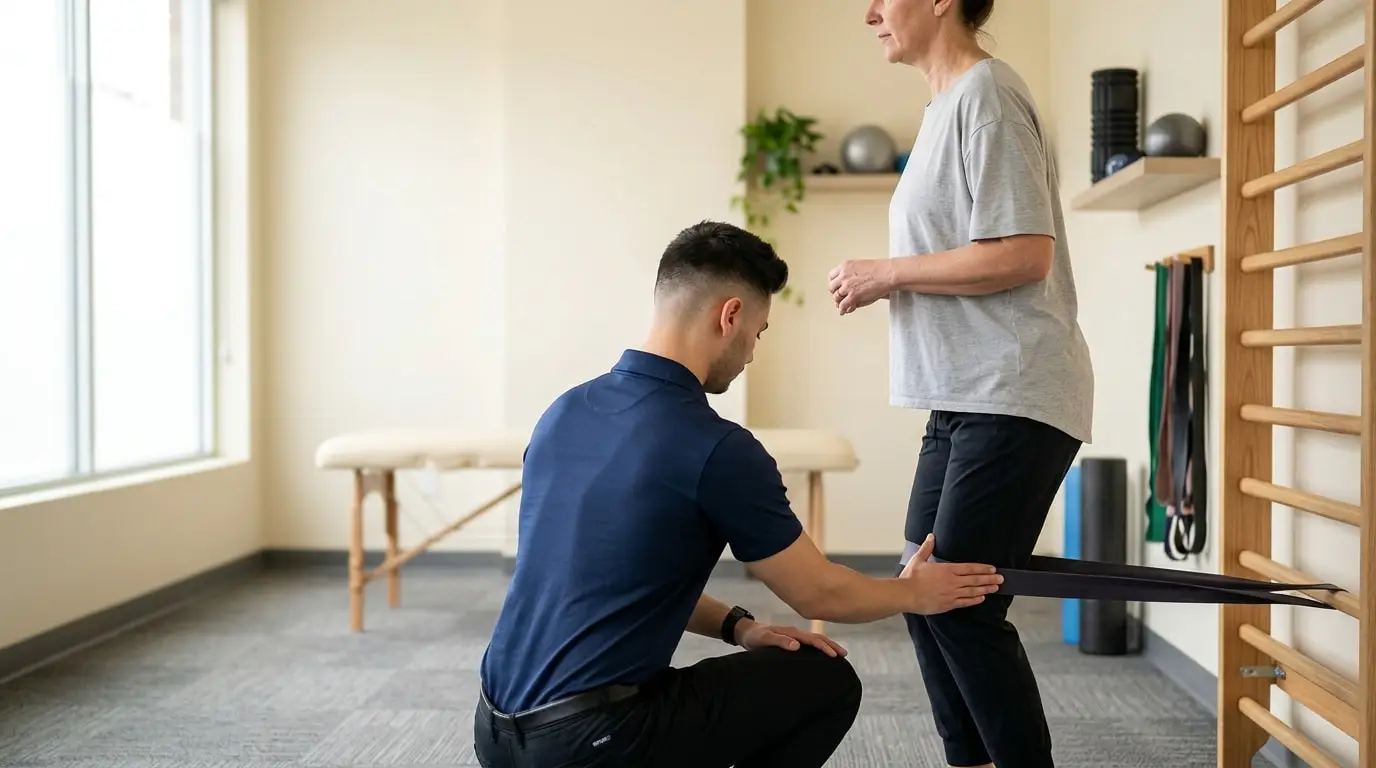
Orthopaedic rehabilitation is an individually planned, phased course of treatment applied after surgery, trauma or in conditions requiring longer-term follow-up related to the musculoskeletal system. Its aim is not merely to relieve pain, but to return the person gradually to their previous level of activity — their work, their sport and their daily life — while respecting the tissue’s healing process. Manual therapy techniques, therapeutic exercise programmes and, where needed, complementary applications are used as parts of this process.
The Core Principle: Load Management
The scientific essence of orthopaedic rehabilitation comes down to a single balance: giving a tissue enough load to stimulate healing — but not so much that it disrupts it. This balance shapes every stage of the process.
Every tissue heals at a different rate and responds differently to load: bone, tendon, ligament and cartilage differ in both their healing capacity and their load tolerance. Loading too early or too heavily can delay healing; loading too little slows the recovery of strength and tissue, and can lead to stiffness and muscle loss. Rehabilitation is therefore about finding the narrow but correct path between “rest and wait” and “push and get injured”.
In Which Situations Is It Used?
Orthopaedic rehabilitation covers clinical presentations in which the physiotherapy process is longer and usually multi-stage. In my practice, it is mainly applied in:
- Post-surgical rehabilitation:
- Knee surgery (meniscus repair, anterior cruciate ligament reconstruction, total knee replacement)
- Shoulder surgery (rotator cuff repair, after shoulder dislocation)
- Hip surgery (total hip replacement)
- Lower back and neck surgery (disc operations, after microdiscectomy)
- Ankle and Achilles tendon surgery
- Post-trauma rehabilitation:
- Functional recovery after fractures
- Ligament injuries and conservatively managed cases
- Follow-up after dislocations
- Sports injuries:
- Conservative treatment processes
- Pre-operative (pre-op) preparation period
- Post-operative follow-up
- Longer-term, multi-stage follow-up:
- Recurrent or chronic orthopaedic problems
- Complex clinical presentations requiring planning across several stages
How the process is planned is always determined by the individual and — where relevant — the surgical situation.
The Treatment Process and Its Phases
Unlike manual therapy, orthopaedic rehabilitation is a longer process that requires more planning, and it usually progresses in successive phases.
Assessment. In the first session, the patient history is taken; any radiological findings (MRI, X-ray, CT) and, where relevant, the post-operative protocol (loading and range-of-motion restrictions) are taken into account. The orthopaedic tests and physiotherapy assessments needed to clarify the clinical picture are carried out. Following this assessment, a treatment programme suited to the person — the techniques, exercises, and number and frequency of sessions — is determined.
Early phase (protection). The priority is usually to bring pain and swelling under control, to keep repaired or protected structures safe and — where appropriate — to gradually restore joint range of motion. The goals vary according to the person’s clinical picture.
Middle phase (movement and strength). Exercises aimed at completing range of motion and rebuilding muscle strength come to the fore; functional movement patterns are gradually introduced.
Late phase (return to function). In the final stage, exercises and functional tests supporting the person’s return to daily activities and an active life are applied. The goals and duration of this phase are shaped by the person’s clinical picture and lifestyle.
Progression from one phase to the next is based not simply on “how many weeks have passed”, but on whether specific goals have been met: is pain and swelling under control, is range of motion sufficient, can strength and movement quality handle the next stage. This criteria-based approach makes the process both safer and more individual.
Loading and Timing Decisions
In orthopaedic rehabilitation, decisions rest not on a single piece of information but on several read together. The available medical reports, the surgical technique used, the imaging findings and the state of tissue healing directly influence decisions such as loading, range-of-motion limits and timing. A process that takes this information into account together with the post-operative protocol contributes to treatment progressing safely. Whenever a change requiring attention appears in the clinical findings during treatment, the priority is to recommend medical assessment.
The Role of Manual Therapy and Exercise
At the centre of orthopaedic rehabilitation is therapeutic exercise; this is the main tool for restoring strength, movement and function. Manual therapy techniques, meanwhile, play a complementary role in preparing the ground for exercise, particularly where range of motion is restricted or pain makes exercise difficult. For mechanical musculoskeletal complaints that do not involve surgery or trauma, please see the manual therapy page.
Process, Follow-up and Safety
The duration of orthopaedic rehabilitation varies according to the type of intervention, the rate of tissue healing and the person’s response, and is often longer than other treatment processes. Follow-up is therefore maintained through regular reassessments, and the programme is updated at each stage. The ultimate goal is for the person to become able to sustain their own exercise and movement routine safely, and to return to the highest possible level of function. In the post-operative period in particular, respecting the surgical limits (loading and range-of-motion restrictions) is essential; where signs such as unexpected increases in swelling, fever, or pain that does not ease with rest and worsens at night appear, the priority is referral for appropriate medical assessment.
You can book an appointment for an assessment and to plan your orthopaedic rehabilitation.
This content is for informational purposes only. It is not intended as medical advice. Please consult your physician and physiotherapist for any health concerns.